Solar farms in small rural counties tend to bring a mix of steady tax revenue and private lease income, short bursts of construction jobs, some modest long‑term employment, and real land‑use tradeoffs that can help or hurt depending on how they are sited and regulated.
Money to landowners and counties:
Utility‑scale projects usually pay landowners much more per acre than typical farm rents and often lock in 30‑ to 35‑year contracts, which can be financially stabilizing in volatile ag markets.
Studies of grid‑scale solar find lease income in some regions exceeding tens of millions per year when spread across participating farms, injecting new private dollars into the local economy.
Because solar arrays are taxable infrastructure, they can add tens to hundreds of millions of dollars in taxable property value in a single county, generating new annual revenue for schools and county government, sometimes on the order of tens of millions over a project’s life.
Developers typically consume few county services (no students in schools, minimal public safety load), so much of that revenue is net‑positive for local budgets.
Jobs and local business activity:
Construction of a large solar farm can create a few hundred short‑term jobs and several million dollars in local economic activity if contractors and workers are hired locally rather than imported.
Long‑term, the number of permanent on‑site jobs is modest—often measured in single digits to a few dozen—but ongoing operations and maintenance still support some local service work (vegetation management, electrical, security).
Local hotels, restaurants, equipment rental companies, and suppliers can see temporary but noticeable boosts during the 12–24 months of construction. (With Saluda County having a scarcity of these type businesses, most of that economic activity goes to adjacent counties.)
Land use, farming, and property values:
Solar farms can convert cropland or timberland into industrial‑scale energy sites, which raises concerns about loss of “prime farmland” and changes to the rural landscape.
Evidence is mixed but increasingly shows that agricultural land near solar and wind projects often stays in agriculture and that adjacent land values are not necessarily harmed; in some cases, access to new transmission infrastructure can even raise nearby ag land values.
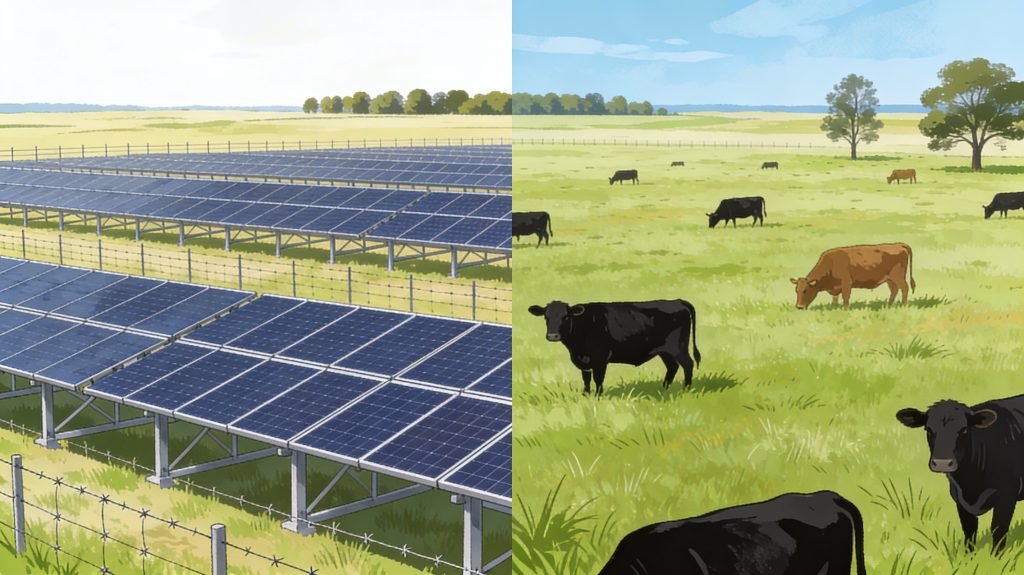
Some projects use agrivoltaics—running sheep, cattle, or certain crops under and between panels—which can preserve some productive use and reduce erosion and evaporation, but this is still the exception rather than the rule and requires careful design.
Environmental and infrastructure effects:
Properly managed sites can reduce soil erosion with permanent vegetative cover and create habitat for pollinators and wildlife, but poorly managed sites risk compaction, drainage problems, runoff, and invasive species.
Solar farms can slow pressure to build new fossil‑fuel generation, which reduces local air pollution and water use compared with coal or gas plants, though most of those environmental benefits are regional rather than uniquely local.
New projects often require upgraded transmission lines or substations, which can bring both benefits (grid reliability, potential for future industrial loads) and tensions over easements and eminent domain.
Politics, control, and “who really benefits:”
At the county level, the real leverage point is how you negotiate zoning, setbacks, decommissioning bonds, and tax abatement deals so you keep tax benefits without giving away more than you get.
Where counties have adopted clear ordinances—protecting prime soils, requiring reclamation, and limiting visual impacts—solar can function as one more economic tool in a diversified rural base rather than a takeover of the landscape.
Where rules are weak, the main winners can be out‑of‑area developers and utilities, while locals bear the visual change and land conversion with less say in siting and fewer long‑term jobs.
Solar Farming may be a smart move for Saluda County, but it must be approached intelligently and thoughtfully, with consideration for all.