Does Saluda County Really Have a High Property Tax Burden?
We Ran the Numbers on All 46 Counties.
A data review from the Saluda County Republican Party
You hear it at the coffee shop, at the ball field, and around the dinner table: “Our taxes are sky-high.” And where millage is concerned, it’s true — Saluda is a small, rural county, and our millage rate is on the higher side. But millage by itself is only half the story. The number that actually lands in your mailbox depends on two things: the millage rate and what your property is worth.
So, we decided to settle the question with hard data. We pulled the official U.S. Census Bureau figures for every one of South Carolina’s 46 counties and compared what homeowners actually pay — not in theory, but in real dollars and as a share of home value.
Here is what we found.
The Bottom Line
When you measure the effective property tax rate — the median tax bill divided by the median home value, which is the fairest apples-to-apples comparison — Saluda County ranks 23rd out of 46 counties. That is dead center. Literally the middle of the pack.
- Saluda’s effective rate: 0.51% of home value
- South Carolina statewide average: 0.48%
- Median county rate: 0.51% — the same as Saluda
In other words, Saluda sits almost exactly on the statewide average and right at the median for all counties. We are not a high-tax outlier. Twenty-two counties tax their homeowners at a higher effective rate than we do — including Richland, Newberry, Spartanburg, Greenwood, and Sumter.
What Saluda Homeowners Actually Pay
Here is the part that surprises people: Because our home values are lower than most of the state, the actual dollar amount on a typical Saluda tax bill is among the lowest in South Carolina:
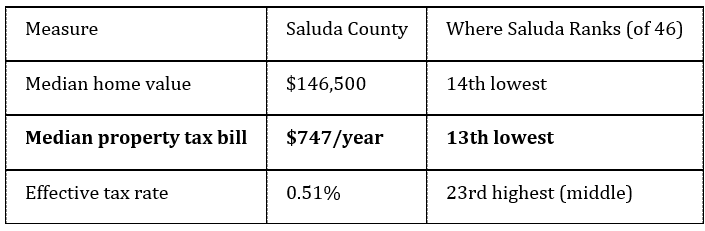
A typical Saluda homeowner pays about $747 a year in property taxes. Compare that to what comparable counties across the state pay:
- Abbeville: $782
- Barnwell: $775
- Edgefield: $875
- Fairfield: $776
- McCormick: $948
- Newberry: $1,154
- Saluda: $747
The complaint about “high millage” holds a grain of truth — our millage rate is higher than in wealthy coastal counties. But high millage on a modestly-valued home produces a modest tax bill. That is the whole point that gets lost in the conversation.
Why Rural Counties Have Higher Millage
This isn’t a Saluda problem — it’s a math problem that every small rural county in South Carolina faces. When you look at the counties with the highest effective rates, they’re almost all small and rural: Allendale (0.88%), Bamberg (0.83%), Hampton (0.80%), Barnwell (0.73%), and Williamsburg (0.66%).
The reason is straightforward. A county still has to fund its schools, roads, sheriff, EMS, and courts regardless of how many high-value homes it has. When the property tax base is smaller — fewer homes, lower values, less commercial and industrial property — the millage rate has to be set higher just to raise the same basic revenue. Wealthy counties with big commercial tax bases and expensive homes can fund the same services at a much lower millage rate.
So a higher millage rate in a rural county is not a sign of waste or over-taxation. It is a sign of a smaller tax base doing the same job.

This Is Exactly Why the Penny Tax Matters
Here is the connection to the Capital Projects Sales Tax renewal on the ballot this November — what most folks call the Penny Tax.
The Penny Tax is a one-cent local sales tax that funds roads, buildings, and other capital projects. And please note: This tax to be voted on in November will not be an additional tax to what we already pay, but a replacement of the current Penny Tax that is set to expires.
Also not that unlike property tax, it is not paid only by Saluda property owners. A large share of it is paid by:
- Visitors and travelers passing through and stopping to buy gas, food, and supplies
- Non-residents who work in or shop in Saluda County
- Everyone, spreading the cost across all spending rather than concentrating it on homeowners
Every dollar we raise through the Penny Tax to build and maintain our roads, facilities, and infrastructure is a dollar we do not have to raise through property taxes. For a county with a small property tax base like ours, the Penny Tax is one of the few tools available to fund big-ticket capital needs without driving up the millage rate on our homeowners.
Let the data speak plainly:
Our property tax burden is average, not excessive —
23rd of 46, right at the state median.
Our actual tax bills are among the lowest in the state —
13th lowest of 46.
The Penny Tax lets us fund capital projects while keeping property taxes low, by sharing the cost with visitors, non-residents, and non-citizens living and working in Saluda County.
If we want to keep our property taxes among the lowest in South Carolina — and keep our millage from climbing to cover capital needs — renewing the Penny Tax in November is the fiscally conservative choice.
It is, quite literally, how a small rural county keeps an undue share of the burden off its homeowners.
Full Comparison: All 46 SC Counties, Ranked by Effective Tax Rate
Ranked from highest burden to lowest.
Saluda is highlighted.
| Rank | County | Median Home Value | Median Tax Bill | Effective Rate |
| 1 | Allendale | $76,200 | $669 | 0.88% |
| 2 | Bamberg | $97,800 | $811 | 0.83% |
| 3 | Hampton | $112,000 | $897 | 0.80% |
| 4 | Barnwell | $106,000 | $775 | 0.73% |
| 5 | Richland | $242,800 | $1,637 | 0.67% |
| 6 | Newberry | $173,300 | $1,154 | 0.67% |
| 7 | Williamsburg | $104,500 | $687 | 0.66% |
| 8 | Orangeburg | $115,800 | $749 | 0.65% |
| 9 | Marlboro | $82,000 | $496 | 0.60% |
| 10 | Lee | $104,600 | $599 | 0.57% |
| 11 | Jasper | $325,500 | $1,852 | 0.57% |
| 12 | Chester | $158,300 | $890 | 0.56% |
| 13 | Dorchester | $329,300 | $1,851 | 0.56% |
| 14 | McCormick | $168,700 | $948 | 0.56% |
| 15 | Union | $103,600 | $579 | 0.56% |
| 16 | Clarendon | $158,000 | $883 | 0.56% |
| 17 | Colleton | $162,500 | $900 | 0.55% |
| 18 | Spartanburg | $233,300 | $1,274 | 0.55% |
| 19 | Greenwood | $180,500 | $964 | 0.53% |
| 20 | Sumter | $165,300 | $881 | 0.53% |
| 21 | Dillon | $85,400 | $452 | 0.53% |
| 22 | Fairfield | $151,200 | $776 | 0.51% |
| 23 | Saluda | $146,500 | $747 | 0.51% |
| 24 | Greenville | $299,000 | $1,512 | 0.51% |
| 25 | Lancaster | $329,900 | $1,657 | 0.50% |
| 26 | Lexington | $234,500 | $1,151 | 0.49% |
| 27 | York | $361,300 | $1,740 | 0.48% |
| 28 | Beaufort | $455,600 | $2,174 | 0.48% |
| 29 | Marion | $93,200 | $436 | 0.47% |
| 30 | Kershaw | $217,100 | $1,013 | 0.47% |
| 31 | Berkeley | $310,300 | $1,400 | 0.45% |
| 32 | Anderson | $231,900 | $1,043 | 0.45% |
| 33 | Abbeville | $178,800 | $782 | 0.44% |
| 34 | Cherokee | $142,000 | $614 | 0.43% |
| 35 | Edgefield | $202,700 | $875 | 0.43% |
| 36 | Florence | $177,900 | $756 | 0.42% |
| 37 | Chesterfield | $116,200 | $487 | 0.42% |
| 38 | Darlington | $158,200 | $652 | 0.41% |
| 39 | Aiken | $218,000 | $897 | 0.41% |
| 40 | Georgetown | $289,500 | $1,190 | 0.41% |
| 41 | Laurens | $170,600 | $698 | 0.41% |
| 42 | Calhoun | $172,100 | $704 | 0.41% |
| 43 | Charleston | $489,100 | $1,901 | 0.39% |
| 44 | Oconee | $237,100 | $899 | 0.38% |
| 45 | Pickens | $231,900 | $866 | 0.37% |
| 46 | Horry | $287,700 | $944 | 0.33% |
Source: U.S. Census Bureau, American Community Survey 2020–2024 5-Year Estimates, Tables B25077 (median home value) and B25103 (median real estate taxes paid). Effective rate = median tax paid ÷ median home value.1
The Verdict
Saluda County’s property tax burden is average, our actual tax bills are among the lowest in South Carolina, and the Penny Tax is a key reason we can keep it that way.
This article was prepared by the Voter Education team of the Saluda County Republican Party.
Knowledge is Power
- A Note on the Numbers: These figures come directly from the U.S. Census Bureau — the same official data used by economists, journalists, and government agencies nationwide. “Median” means the middle value, so it reflects a typical homeowner in each county, not the highest or lowest. Your individual bill will vary based on your specific property value, exemptions (like the owner-occupied 4% assessment ratio and homestead exemptions), and local district millage. But for comparing counties on a level playing field, the effective tax rate is the gold standard. ↩︎