It all started in 1812…
The first Congressional Redistricting took place in 1812, and it was a “gerrymander” of gigantic proportions. It spawned the term “gerrymander” from the name of Founding Father and Massachusetts Governor, Elbridge Gerry. Of all his substantial accomplishments and high offices, Gerry, is mostly remembered for giving his name to “gerrymandering,” the practice of manipulating electoral district boundaries for political advantage. He signed the first bill approving a gerrymandered redistricting plan in 1812. Gerry was a Democrat.
For almost two hundred years Democrats held control of far more states than Republicans, so they had a distinct advantage in Congress during that time. Since the 1990’s, however, Republicans began to gain ground.
1990s Cycle (Post-1990 Census)
Democrats held “trifectas,” i.e. full control of the governorship and both houses of Congress in 21 states. These states were comprised of 172 congressional seats in 1991, when the standard, and expected, redistricting after the census was undertaken. This was considered a standard decennial redistricting cycle and, historically, is counted as one instance of Democratic-controlled redistricting in these states. No widespread mid-decade redistricting by Democrats is noted for this period, though some states faced court-ordered adjustments due to litigation (e.g., Voting Rights Act challenges).
2000s Cycle (Post-2000 Census):
Democrats held trifectas in 12 states covering 135 congressional seats in 2001. They redistriced in all 12, to their favor. This again is counted as one instance of Democratic-controlled redistricting.
In 2005, however, a notable mid-decade redistricting occurred in Georgia, where Democrats, after gaining control in the 2004 election, redrew maps to favor their party. This is considered an additional instance of Democratic redistricting.
2010s Cycle (Post-2010 Census):
By 2011, Democrats had a weaker position, holding trifectas in only six states – Illinois, Nevada, New Mexico, New York, Oregon, and Rhode Island. They also had effective control in Maryland and Massachusetts (via veto overrides), covering fewer seats than Republicans. This, again, counts as only one instance of Democratic-controlled redistricting in these states, even though redistricting to the benefit of Democrats was done in eight states.
In some of those states (e.g., Maryland, New York), Democratic maps were challenged, and courts ordered redraws (e.g., Maryland in 2022 replaced a map with one acceptable to the Republican governor; New York’s map was redrawn by a special master). These court-ordered redraws are not counted as Democratic-controlled redistricting.
2020s Cycle (Post-2020 Census)
Democrats had trifectas in seven states (49 congressional seats) with trifectas and had strong influence in states that had commissions or split control. This counted as one instance of Democratic-controlled redistricting.
Democrats in New York attempted an aggressive gerrymander, but it was struck down by courts, and a special master redrew the map, so this is not counted as a Democratic-controlled redistricting.
Current
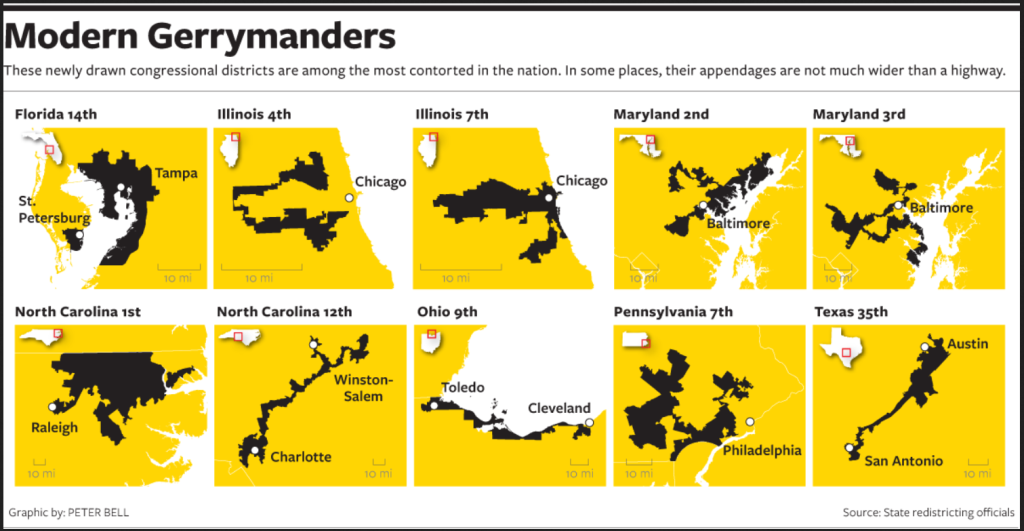
As of 2025, some Democratic-controlled states (e.g., New York, Illinois) have proposed mid-decade redistricting in response to Republican efforts (e.g., Texas), but these proposals (e.g., New York’s bill for 2028) have not been enacted, so they are not counted.
Democrats have redistricted 5 times since 1986 (1991, 2001, 2005 in Georgia, 2011, and 2021). When Democratic Congressmen fled to Illinois recently to keep Texas Republicans from passing their midterm redistricting plan, they were, essentially crying foul about a practice they undertake themselves whenever they have the opportunity.