The original goal of redistricting in the U.S. political system was to ensure that representation in the House of Representatives accurately reflected shifts in population, so each district would have roughly equal populations. This was meant to uphold the Constitutional principle that representation should be “proportionate” to the number of people, preventing some areas from being overrepresented and others underrepresented as populations changed over time.
This goal, rooted in Article I, Section 2 of the Constitution, required that congressional districts be redrawn after each census in order to adjust for population changes and keep representation equal. The basic aim was to ensure fairness: to realign legislative district boundaries so that everyone’s vote carried similar weight and Congress reflected the people as accurately as possible.
The Number of Representatives shall not exceed one for every thirty Thousand, but each State shall have at Least one Representative; and until such enumeration shall be made, the State of New Hampshire shall be entitled to chuse three, Massachusetts eight, Rhode-Island and Providence Plantations one, Connecticut five, New-York six, New Jersey four, Pennsylvania eight, Delaware one, Maryland six, Virginia ten, North Carolina five, South Carolina five, and Georgia three.
Article I, Section 2 of the Constitution (excerpt)
Ideally, districts should be as compact as possible, contain fairly a fairly equal number of residents, and not cut across communities. But as with most things political, what was well-intentioned, was quickly corrupted by the use of “gerrymandering.”
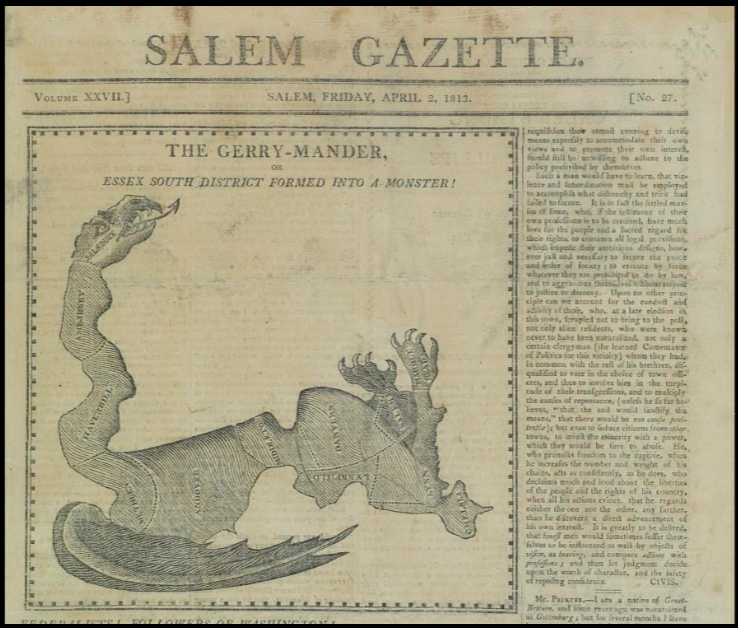
In 1812, The Democratic-Republican Party drew a weird shaped district for a state senatorial seat. Governor Elbridge Gerry, himself a Democratic-Republican, did not really like the plan, but signed it anyway. On Friday, April 12, 1812, an illustrator for the Boston Gazette published a cartoon of the odd shaped district, naming it the Gerry-Mander – a name that has certainly stuck.
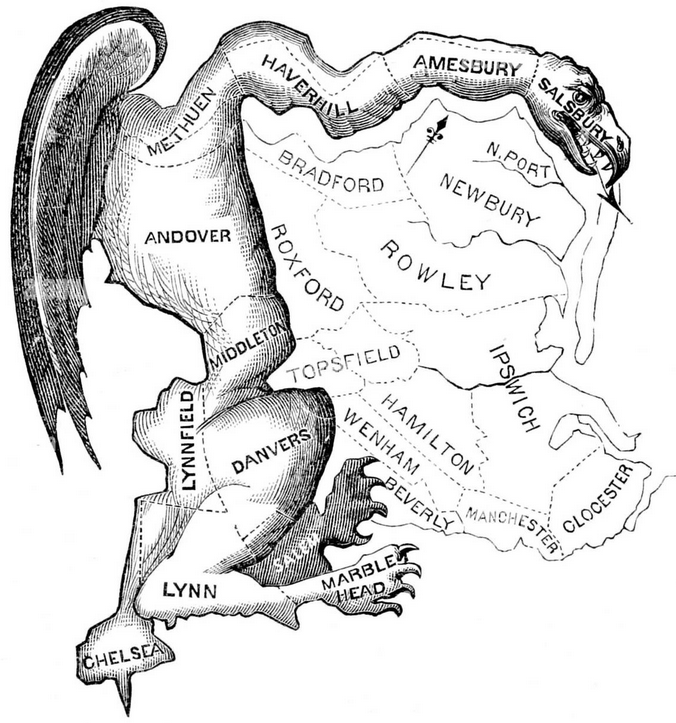
Almost all gerrymandering since 1812 has been done for either racial or political purposes, or a combination of the two.
While gerrymandering has remained a persistent feature of U.S. politics, its methods have become more sophisticated with advances in data and technology, especially since 2010. Powerful computers and detailed demographic data let parties gerrymander with much greater precision. The practice has shaped outcomes in both state legislatures and Congress, helping parties cement power for decades, even as population changes or overall votes favor the other side.