Americans often hear complaints that our country is “stuck” with a rigid two‑party system. But that criticism misses two important realities. First, the Constitution never created political parties at all. Second, it certainly didn’t restrict the nation to two. South Carolina, for example, currently recognizes nine certified political parties. The structure we have today didn’t come from a legal requirement — it came from human nature.
Political parties don’t appear because someone decides the country needs them. They grow out of a simple discovery: people who share ideas and goals can push those ideas further by working as a team than by acting alone.
Disagreement Comes First — Organization Comes Later
Citizens bring different experiences, priorities, and beliefs into public life. James Madison understood this clearly in Federalist No. 10, writing that the causes of faction are “sown in the nature of man.” People differ in their opinions, their passions, and their interests — including how property is distributed. Those differences naturally lead people to cluster with others who see the world similarly.
The party label comes after the alliances form.
America’s early history proves this. Many founders distrusted parties and hoped the new republic could operate without them. Yet parties emerged anyway. Alexander Hamilton pushed for a stronger national government and a modern financial system. Thomas Jefferson and James Madison opposed major parts of that program. Debates over debt, the national bank, and foreign relations pulled supporters into recognizable camps. The Library of Congress describes this period as the “rapid evolution of political parties from factions.”
Americans didn’t invent parties and then go looking for disagreements. The disagreements created the alliances.
Why Parties Form: The Power of Teamwork
An individual can write a letter, speak at a meeting, or support a candidate. A team can coordinate those efforts, keep the message alive after one person tires, and turn arguments into sustained pressure. Political scientist John Aldrich has argued that parties emerge because people repeatedly face the same practical problem: assembling support over and over is inefficient. A standing organization reduces that friction.
One person brings an argument. Another brings local knowledge. Another brings organizational skill. Another is willing to run for office. Their contributions reinforce one another. That’s the value of a political party: it amplifies individual effort into collective strength.
This doesn’t require everyone to agree on every issue. A useful political team finds enough common ground to act while still leaving room for persuasion and debate. There’s a difference between combining your voice with others and surrendering your judgment. Organization can amplify good judgment or poor judgment — the results still need to be evaluated by whether they respect rights and serve broader purposes.
But the case for parties remains the same: teamwork carries farther than any one voice can alone.
Today’s Political Differences Are Differences of Principle
Parties exist because disagreement is a permanent feature of public life and cooperation is the practical response. At their best, parties allow individuals to keep their own judgment while adding their effort to a shared cause.
That reality has never been clearer than it is today. The differences between America’s two major parties are no longer matters of degree or emphasis. They are differences of principle — about the size and purpose of government, the meaning of citizenship, the preservation of individual rights, the protection of traditional American culture, and the role of the United States in the world.
Republicans settled on their candidates earlier this summer. Those nominees ran on a platform shaped by the priorities of the voters who selected them. As the midterm election approaches, the practical question is whether that platform will have the votes in Congress and in statehouses to shape policy.
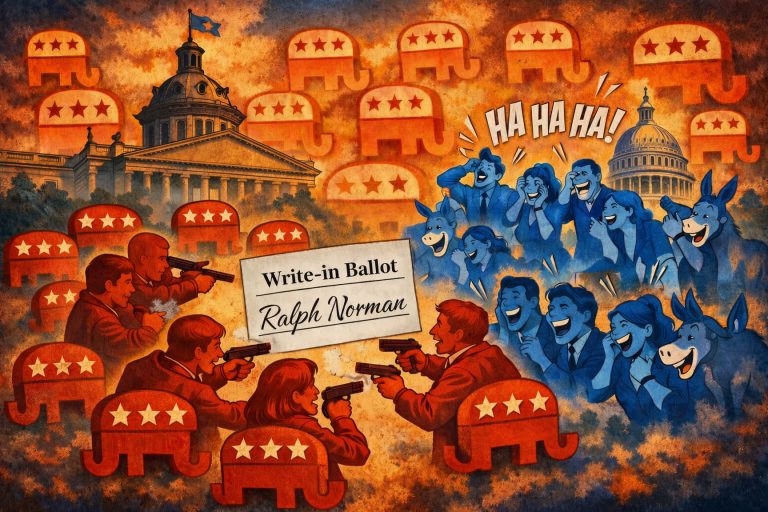
Fragmented ballots and third‑party gestures may feel like expressions of independence. But they dilute the very teamwork the party system was built to provide.
Why Voting a Straight Republican Ticket Matters
If the goal is for Republican ideas to predominate — limited government, national sovereignty, strong national defense, constitutional rights, and respect for the rule of law — then the most direct means available is to vote a straight Republican ticket.
That choice does not require abandoning independent judgment on every issue. It simply recognizes a practical truth: on the questions that now divide the parties most sharply, organized cooperation is the way an individual voice travels farther than it can alone.
Political parties exist because Americans disagree — and because Americans know that working together is the most effective way to turn principles into policy. Voting a straight ticket is how individual conviction becomes collective strength.