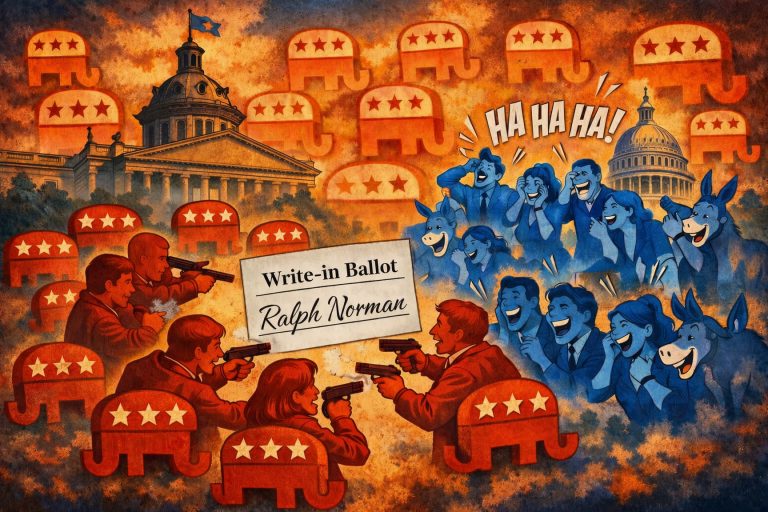
The South Carolina Republican Senate primary is over.
Darline Graham defeated Ralph Norman in the August 25 runoff and is now the Republican nominee for the November 3 general election.
For the many Republicans who supported Norman, disappointment is understandable. They preferred an experienced, proven conservative and had legitimate questions about Graham’s experience and campaign performance.
But a primary has a purpose: Republicans argue among themselves about who should represent their party. Sometimes fiercely.
Then somebody wins.
The question now is different.
Staying Home Sends No Message
Some disappointed voters are considering simply not voting in the Senate race.
They may intend that as a protest. But election returns do not record why someone stayed home. There is no column for “Norman voter angry about the primary.” There are only votes cast and votes not cast.
The battle over the direction of the Republican Party will continue in future primaries, conventions, candidate recruitment and leadership contests.
The general election answers another question: who gets the Senate seat?
A Protest Vote Dissipates into Meaninglessness
The same is true of voting third party or writing in another name.
Such a vote can express dissatisfaction. It cannot change the August result.
Norman lost. Graham won.
That distinction matters because there are really two political contests involved here:
Who should lead the Republican Party?
and
Which party should hold this Senate seat?
They are connected—but they are not the same fight.
The Biggest Reason not to Vote for Annie Andrews
Some disappointed Republicans are even considering voting for Democrat Annie Andrews, a pediatrician.
That position actually makes her frequent appeal to science and “evidence-based” medicine even more egregious.
In 2022, Andrews said she opposed gender-transition surgery for anyone under 18 but supported “evidence-based medical care, with parental consent,” for teenagers struggling with gender-identity issues.
But surgery is not the only disputed intervention.
Puberty blockers and cross-sex hormones raise separate questions about fertility, bone development, sexual development, psychological outcomes and the permanence of some physical effects.
Systematic reviews have found substantial uncertainty and low or very low certainty evidence concerning important outcomes of these treatments in minors. At the same time, parts of the medical community continue to dispute how those findings should affect clinical practice.
So the proper question is not whether anyone is “for science” or “against science.”
It is whether the phrase “evidence-based” gives parents and voters a complete picture when the long-term evidence itself remains contested and limited.
Andrews’s opposition to surgery alone does not answer where she stands on puberty blockers, cross-sex hormones, age limits, psychological assessment or informed-consent protections. It can simply be a dodge to hide her willingness to support the Democrat party stand on transgender issues.
Her vagueness on the issue is not an adequate safeguard for South Carolina’s children against this disastrous Democrat Party stance.
Some Fairness is in Order for Darline
Norman voters do not have to forget their concerns about Darline Graham simply because she won.
Like anyone else, she deserves to be judged on what she actually does. Being Lindsey Graham’s sister will not hide her record. In fact, it will insure closer scrutiny.
Graham has already taken several positions that give voters something concrete against which to measure her future performance.
She has emphasized domestic concerns more heavily than the international affairs closely associated with her late brother.
She cosponsored the SAVE America Act and said she was willing to keep the Senate in session to pass it.
Most notably, she publicly broke with her brother on the Senate filibuster. At the televised debate between Graham, Norman, Fry, and Sanford, Graham stated clearly: “I am all for—this is where I differ from my brother—getting rid of the filibuster to get this done, because eventually the Democrats are going to get rid of it anyway.”
That statement was made specifically in connection with passing the SAVE America Act.
Those positions do not answer every question about Graham.
But they are promises all conservative voters should support—and a record they can eventually judge.
Staunch Conservatives have already changed the Republican Party
One primary result should also be kept in perspective.
The Republican Party of 2026 is very different from the Republican Party Donald Trump entered more than a decade ago.
America First and MAGA voters are dominant in the GOP. Pew’s 2026 political typology identifies strongly Trump-supporting conservative groups as ideological anchors of the Republican coalition.
That transformation did not happen by winning every primary.
Political movements rarely do.
They win some battles and lose others.
They change candidates first, officeholders next, and eventually—if their influence continues—committee chairmen, congressional leadership and the institutions that determine what legislation actually moves.
That takes time.
One Battle is not the War
Norman supporters can remain disappointed. They can question Graham. They can watch her votes. They can hold her to her promises.
And when the next Republican primary arrives, they can fight just as hard again for the candidates they believe best represent them.
That is how political parties change.
The August primary answered one question.
November will answer another.
And the much larger struggle over what the Republican Party becomes—and who ultimately leads it—will continue long after both elections are over.
We America First/MAGA voters have spent the past ten years fighting for the Republican Party. Against great odds. We have taken losses. We have taken far more wins.
We cannot stop fighting for the principles our party stands for now.