As a general practice, we do not highlight legislation that is still sitting in committee. Our goal is always to provide clear, timely information once a bill has moved far enough along for citizens to take meaningful action.
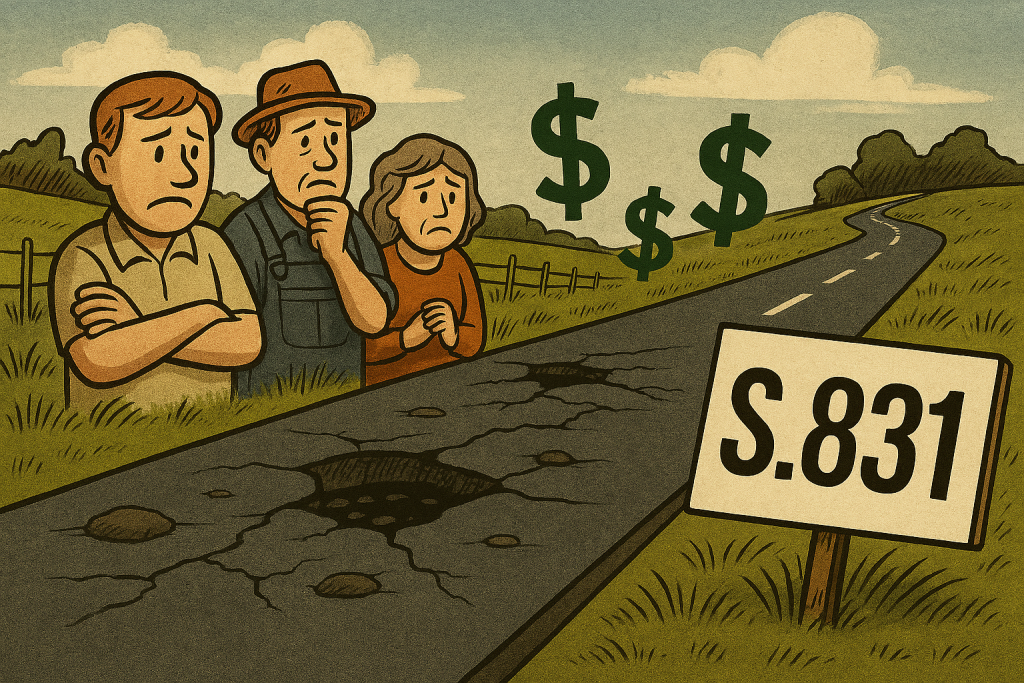
But the SC DOT Reform Bill (S.831) is different.
The condition of state‑maintained roads in Saluda County has reached a point where waiting quietly on the sidelines is no longer responsible. Families, farmers, school buses, first responders, and local businesses depend on these roads every single day. When a bill directly affects who maintains those roads — and who pays for them — our community deserves to know what is coming.
Who Maintains What in Saluda County
One of the most common misunderstandings in our county is who is responsible for which roads.
- Saluda County DOT maintains dirt roads.
- South Carolina DOT (SCDOT) maintains nearly all paved roads, including Highways 378, 39, 121, 23, and many of the secondary paved routes that connect our homes, churches, and farms.
This distinction matters because the SC DOT Reform Bill includes language allowing the state to transfer “non‑essential” roads to counties or municipalities. While the bill describes this as voluntary, history has shown that rural counties often feel pressured to accept these transfers.
For a county with a small tax base and a large geographic footprint, this could have serious long‑term consequences.
What the Bill Proposes
The SC DOT Reform Bill is framed as a modernization effort. It includes provisions to:
- Create a statewide Transportation & Mobility Council
- Strengthen internal oversight at SCDOT
- Allow public‑private partnerships
- Update fees for alternative‑fuel vehicles
- Add impact fees on new developments
- Allow toll express lanes in congested areas
- Transfer certain roads from SCDOT to counties or municipalities
Some of these reforms may help streamline planning and improve statewide coordination. But for rural counties like ours, the road‑transfer provision is the one that deserves the closest scrutiny.
How This Could Cost Saluda County More
If the state transfers paved roads to the county, the responsibility — and the cost — comes with them. That means:
1. Higher Maintenance Costs
Paved roads require:
- Resurfacing
- Striping
- Shoulder and ditch maintenance
- Bridge and culvert upkeep
These are far more expensive than maintaining dirt roads. Saluda County’s current budget is not built to absorb these costs without significant adjustments.
2. Pressure on Local Taxes
If the county inherits more paved roads, it may eventually need to consider:
- Higher property taxes
- Increased vehicle fees
- Cuts to other essential services
This shifts the financial burden from the statewide system to the people of Saluda County.
3. Long‑Term Liability
Once a road becomes a county road, the county becomes responsible for:
- Emergency repairs
- Storm damage
- Accident‑related liability
- Bridge failures
These liabilities can strain a rural county budget for decades.
4. Rural Counties Are Hit Hardest
Urban counties have larger tax bases and more diversified revenue streams.
Rural counties do not.
This bill could unintentionally widen the gap between urban and rural infrastructure quality.
Why We Are Speaking Up Now
Saluda County residents have been clear: our roads need attention.
We cannot afford to lose ground.
Even though this bill is still in committee, the potential impact on our county is too significant to ignore. If we wait until the bill is already moving quickly, it may be too late for rural voices to shape the outcome.
Our responsibility as community advocates is to ensure that Saluda County families, churches, farmers, and small businesses are informed early enough to act.
How Citizens Can Stay Informed and Take Action
This is a moment when citizen engagement truly matters.
Follow the Bill
You can track S.831 in real time using FastDemocracy, a free tool that shows:
- Bill text
- Amendments
- Committee actions
- Votes
- Movement between chambers
- Bill up for public hearing • Senate Transportation Subcommittee, Feb 04, 2026 11:00am, Gressette Room 308
Simply search for “S.831” to see its current status.
Contact Your Legislators Now
Lawmakers need to hear directly from the people who drive these roads every day.
Your voice matters more than you may realize.
🏛️ Legislators Representing Saluda County
📬 How to Contact Them
Senator Shane Massey
- Email: shanemassey@scsenate.gov
- Phone: 803‑212‑6410
- Office Address: 606 Gressette Building, Columbia, SC 29201
- District Includes: Saluda, Edgefield, Aiken, McCormick
Representative Cal Forrest
- Email: calforrest@schouse.gov
- Phone: 803‑212‑6897
- Office Address: 420B Blatt Building, Columbia, SC 29201
- District Includes: Saluda and parts of Lexington County
When you reach out, consider sharing:
- Your concerns about road transfers
- How state‑maintained roads affect your daily life
- The financial strain this could place on rural counties
- The need for protections against unfunded mandates
Early communication ensures that Saluda County is not overlooked in the legislative process.
Final Thoughts
The SC DOT Reform Bill has the potential to reshape how South Carolina manages its transportation system. Some reforms may be beneficial. But the possibility of shifting paved roads — and their costs — onto rural counties is a serious concern.
Saluda County already works hard to maintain its dirt roads with limited resources. Taking on additional paved roads without adequate funding would place a heavy burden on our citizens.
Our goal is simple:
To protect the people of Saluda County and ensure that our rural community is treated fairly.
We will continue monitoring this bill and providing updates as new information becomes available.