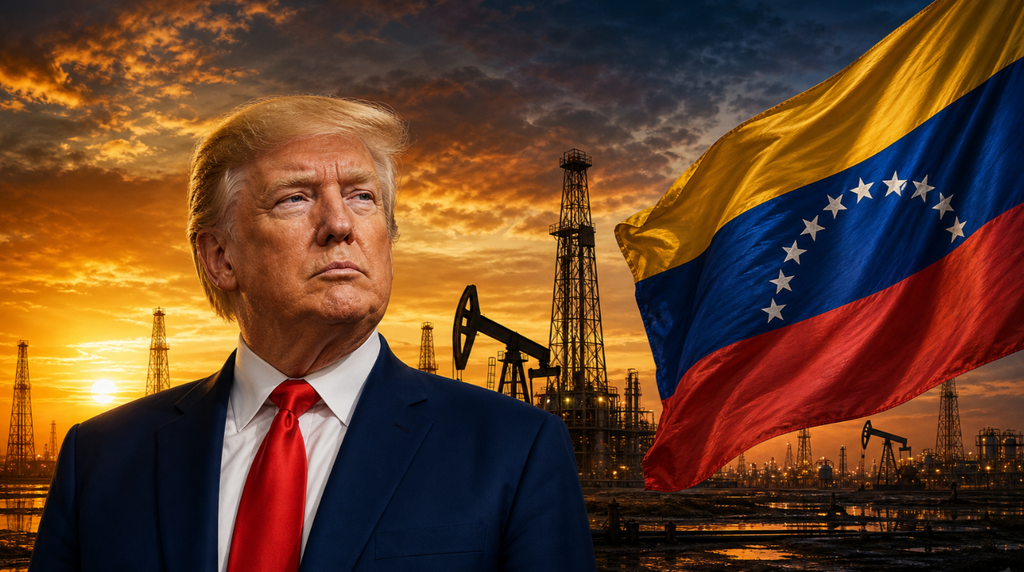
President Donald Trump’s historic Venezuela oil agreement represents more than an energy deal. It reflects a different approach to foreign policy—one that uses America’s greatest strengths, especially its capital, technology, energy resources and economic power, to create relationships in which both sides have a reason to maintain peace and stability.
At a time when America’s Strategic Petroleum Reserve has been depleted to historically low levels, the agreement could also provide the United States with a long-term, preferential source of energy from one of the largest oil reserves in the world.
The White House says the agreement gives the United States significant control and preferential access to production from 17 Venezuelan oil fields containing approximately 65 billion barrels of proven reserves. The venture is expected to attract up to $100 billion in investment to rebuild Venezuela’s devastated oil industry. The U.S. government will receive a 35% equity stake in the venture, while the State Department will have the right to purchase 20% of its production at cost and first refusal on the remaining production.
A Different Way to Think About Peace
For decades, American foreign policy has often approached unstable countries primarily through sanctions, foreign aid, diplomacy or military intervention.
Trump’s approach is different.
If two countries can benefit economically from working together, they have a powerful reason to preserve the relationship.
That does not mean ignoring military strength or national interests. Quite the opposite. Trump’s philosophy is that American strength creates the leverage necessary to negotiate from a position of power—and that economic relationships can turn that strength into lasting mutual interests.
The Venezuela agreement is a striking example.
America needs reliable energy supplies, greater access to oil, a stronger Strategic Petroleum Reserve and less dependence on potentially hostile foreign powers.
Venezuela needs capital, technology, infrastructure, jobs and a functioning energy industry.
Those interests do not have to conflict. They can reinforce one another.
The United States brings what Venezuela desperately needs: investment capital, advanced technology, refining capacity, engineering expertise and access to the world’s largest consumer market.
Venezuela brings something America needs: enormous energy reserves located in the Western Hemisphere.
The result is a relationship in which American prosperity and Venezuelan prosperity can become mutually reinforcing.
Strength Creates the Opportunity
This is also why the deal should not be viewed simply as an oil transaction.
Russia and China have spent years expanding their economic and strategic influence in Venezuela. The new arrangement moves major Venezuelan energy assets toward American investment and oversight.
That is a significant shift in the balance of power in the Western Hemisphere.
America does not need to dominate Venezuela to benefit from a stable and prosperous Venezuela. It needs Venezuela to have a reason to prefer partnership with the United States over dependence on Russia, China or other outside powers.
Economic opportunity can create that reason.
When American companies build infrastructure, employ workers, purchase equipment and develop energy resources, they create relationships that extend far beyond a single political administration. When Venezuela earns billions in royalties and taxes from increased production, it gains an economic interest in maintaining the stability necessary for those investments to succeed. And when American consumers and businesses gain access to additional energy supplies, the United States gains greater economic and national-security resilience.
That is mutually beneficial power—not foreign aid and not permanent dependency.
An Answer to America’s Strategic Oil Problem
The timing is particularly important.
America’s Strategic Petroleum Reserve has been drawn down dramatically over the past several years. Its inventory has fallen to levels not seen since the early 1980s, reducing the nation’s cushion against a major disruption in global oil supplies.
The Venezuela agreement does not immediately put 65 billion barrels into the SPR. Venezuelan crude is generally heavier than much of the crude traditionally stored there, and rebuilding Venezuela’s production will take substantial investment and time.
But the agreement gives the United States a preferential right to purchase 20% of the venture’s production at cost, which the administration says can help replenish the Strategic Petroleum Reserve and provide oil for military and other national-security needs.
That creates something America badly needs: a long-term strategic supply relationship in the Western Hemisphere.
Instead of waiting for the next international crisis and then competing on the open market for scarce supplies, the United States can help develop additional production now and establish preferential access before the next crisis occurs.
Energy security is national security.
Peace Through Prosperity
The broader principle is important.
Poor, unstable countries are fertile ground for authoritarianism, criminal networks and foreign influence. Prosperous countries with functioning economies have more to lose from instability.
That is why economic development can be a tool of national security.
If Venezuela’s oil industry is rebuilt, Venezuelans gain jobs and economic opportunity. The Venezuelan government gains tax and royalty revenue. American companies gain new markets and investment opportunities. American consumers gain another source of energy. And the United States gains greater influence over a strategically important country in its own hemisphere.
Everyone has something to lose if the relationship fails.
That is precisely the kind of mutual interest that can create stability.
Trump’s approach is, therefore, not simply “America First” in the sense of looking inward. It is America First by using America’s strengths to create relationships that benefit America while giving other countries a compelling economic reason to cooperate with us.
America has tremendous advantages: the world’s largest economy, abundant energy resources, deep capital markets, technological leadership, world-class businesses and the most powerful military on Earth.
The question is how those advantages are used.
The Venezuela agreement offers one possible answer:
- Use American strength to create American prosperity.
- Use American prosperity to build mutually beneficial relationships.
- And use those relationships to make peace and stability more valuable than conflict.
That is a very different model from endless foreign aid, endless sanctions or endless wars.
It is peace through strength—and prosperity through mutual benefit.
And if it succeeds, the Venezuela agreement could demonstrate what happens when America stops viewing its economic power simply as a domestic asset and begins using it as one of its greatest tools of national security and peace.