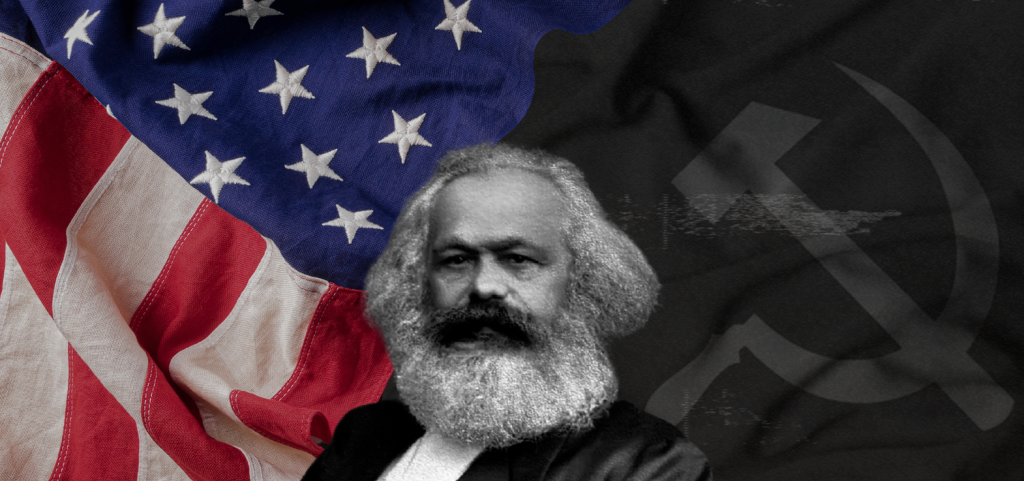
Karl Marx taught that society is a constant war between “oppressors” and “oppressed,” and that capitalism must be torn down and replaced by a system where the government or “the people” control the economy. In his world, private ownership, free markets, and profit are not engines of opportunity—they’re tools of exploitation that must be dismantled.
Socialism is the first step: more and more, “a little socialism” means government assumes control over jobs, businesses, and money “for fairness.”
Communism is the end goal: no private economic property at all, no classes, and the state eventually claiming to “disappear” after it has done all the tearing down.
How Marxism looks in American politics
Most American politicians aren’t waving red flags or calling themselves communists. Instead, they use softer labels: “democratic socialist,” “progressive,” “for equity,” “for social justice.” But the ideas underneath are strikingly similar: the government, not free citizens, should decide how health care, energy, education, and housing work.
The rich are automatically guilty; success is suspect.
The answer to every problem is a new program, a new tax, a new regulation, and a new federal agency.
When you hear phrases like “political revolution,” “the 99% vs. the 1%,” or “soak the rich,” you’re hearing Marx’s class‑war thinking repackaged for American ears.
Cultural Marxism: not just about money
Marx originally focused on economic class, but his followers pushed the same oppressor‑vs‑oppressed logic into culture: race, gender, religion, sexuality. That’s cultural Marxism. It says our society is rigged top to bottom, and the only way to fix it is to tear down “dominant” .groups and traditions.
That’s how you end up with:
- Schools teaching kids that America is defined by oppression more than freedom.
- Training programs that label entire groups as “privileged” and others as “victims,” no questions asked.
- Corporate HR and DEI offices acting like political commissars, pushing ideology instead of basic fairness.
The goal is the same as economic Marxism: convince people that the existing system—our Constitution, our free markets, our churches, our families—is fundamentally corrupt and must be “transformed.”
What this looks like close to home
You don’t need to go to Washington to see the drift. You can spot it from Horry County to Saluda, from the Upstate to the Lowcountry.
In education: pressure in too many districts to dilute South Carolina history and civic pride—our state’s role in the Revolution, the Constitution, and the old agrarian republic—with national-style curricula heavy on guilt, grievance, and identity politics. More administrators and DEI coordinators, fewer hours on reading, math, and the actual mechanics of American self-government.
In local government and nonprofits: federal and state grants that roll into county offices, school boards, and “community partnerships” with strings attached—DEI mandates, climate action templates, equity audits, and “inclusion” requirements quietly pushed from Columbia or handed down from Washington. These pressures may have lessened or even been rolled back during the Trump administration, but they are not dead. They are just hibernating.
In economics: a slow shift in how we talk about agriculture, small manufacturing, tourism, and family businesses. The idea that South Carolina farmers, contractors, and Main Street owners should bend, not just to practical rules, but to ever-growing layers of regulation, “sustainability” checklists, and top-down “fairness” standards that treat productive citizens as problems to be managed.
Bit by bit, the assumptions change: the South Carolina citizen—independent, church-going, hardworking—becomes the obstacle, and the expanding bureaucracy, consultant class, and grant-funded nonprofits become the indispensable saviors.
South Carolina remains more resistant than most states, but the drift is real, and without constant pushback it will only accelerate.
Why this matters to Saluda County conservatives
Marxism, whether economic or cultural, always attacks the same targets first: faith, family, private property, and local self‑government. Those are exactly the things that keep communities like ours strong and free.
When national elites say parents shouldn’t have the final say in their kids’ education, that traditional Christian beliefs are “harmful,” or that Washington bureaucrats know more about your land than you do, they are not just making policy—they are chipping away at the foundation of a free Republic.
We don’t have to accept that.
What we can do about it
At the county GOP level, we can push back where it matters most—right here.
- Elect officials who understand the difference between helping people and controlling people.
- Demand school boards teach honest history and civics, not ideological guilt trips.
- Support candidates who defend property rights, religious liberty, and parental rights, not “equity” buzzwords.
- Use our local party platforms, websites, and newsletters to explain these ideas in plain English so our neighbors aren’t fooled by soft Marxist rhetoric dressed up as compassion.
Marxism grows when good people shrug and say, “That’s just politics.” It shrinks when informed citizens stand up and say, “No—this is my country, my community, my family, and I’m not handing them over to an ideology that has already wrecked nations around the world.”
The fight against Marxism doesn’t start in Washington. It starts at kitchen tables, school board meetings, county councils, and local GOP gatherings—exactly where you already are.