In 1800, South Carolina did not have specific statutory abortion laws. Like much of the United States at the time, abortion was generally governed by English common law. Under English Common Law, pregnancy was considered to have two stages, based on a concept called “Quickening.” Quickening, which usually happened at 16-20 weeks, was the point at which movement of the child could be felt. Abortions before quickening were typically not prosecuted as crimes, while later-term abortions, i.e. after quickening, could be prosecuted as a misdemeanor or felony depending on circumstances.
In general, however, abortion was viewed and dealt with, largely, as a matter of local will and sensibilities.
1820-1830
South Carolina did not pass its first explicit abortion laws until after the 1820s, following a broader trend in U.S. states
Again, the concept of quickening was foundational to the law: pre-quickening and post-quickening. This distinction—in both English and early American law—rested on the belief that quickening indicated that a fetus had achieved “independent existence.” South Carolina’s statutes followed this common law tradition, imposing harsher penalties post-quickening and lighter ones pre-quickening, but generally making both criminal acts unless the mother’s life was in danger.

If death occurred as the result of an abortion, the penalties were much harsher:

Later 1800s
As the country moved toward a new century, the American Medical Association became more involved in policy-making. South Carolina’s abortion laws—like those in many states—became more restrictive and explicit. Initial statutes from the early 19th century that criminalized abortion primarily after quickening were strengthened during this period.
The statutes were revised to criminalize all attempts to procure an abortion, regardless of the stage of pregnancy, with harsher penalties for procedures performed after quickening. Language was also expanded to include any means or substances used to induce abortion, reflecting advances in medical techniques and growing professionalization of medicine.
These new laws included exceptions if the procedure was necessary to save the life of the mother, but otherwise they sought to prevent both self-induced and physician-assisted abortions. These changes mirrored a national trend driven by the American Medical Association’s push to criminalize abortion and regulate medical practice to protect the life and health of mother and child.
The specific statutes were:
- § 16-87 criminalized providing, prescribing, or administering any substance or employing any means to induce an abortion unless necessary to save the mother’s life.
- § 16-88 imposed penalties for violations, generally making the act a felony.
- § 16-89 exempted actions done to save the life of the mother from prosecution.
The statutes made virtually all abortions illegal in South Carolina except when necessary to preserve the woman’s life, imposing criminal penalties on providers but not on the woman herself.

in The State of South Carolina v. Steadman, a famous case heard during the first part of the next century, a lower court had found abortionist, Ida Steadman, guilty for performing an abortion resulting in the death of a child when the mother was, allegedly, “quick with child.” That conviction was overturned by the SC Supreme Court because there was no evidence the woman had been quick with child. The court also ordered a new trial.
The second Steadman trial, on the charge of performing an abortion before quickening, Steadman was found guilty. During that trial, the State was able to present evidence that Steadman had performed previous abortions. She was sentenced to 5 years in prison and fined $1000.
Legal Importance of Steadman
The Steadman cases clarified that South Carolina law recognized two separate crimes: one for abortion when the woman was quick with child (with harsher penalty), and another for abortion at any stage (with lesser penalty). The case also set precedent on how courts must corroborate evidence and how previous similar acts could be introduced in abortion trials.
Though Steadman was first tried in 1948, the laws involved were all passed in the 1800s.
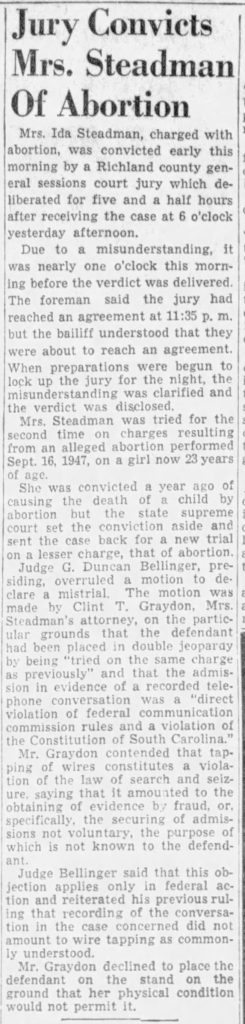
Thursday, May 26, 1949
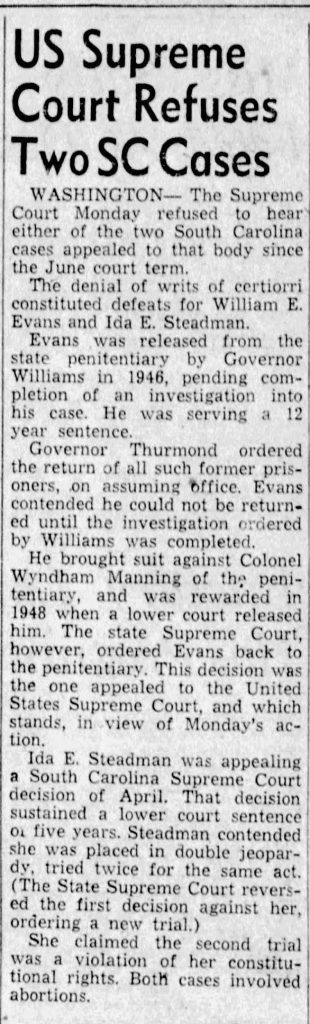
October 18, 1950

October 23, 1950

Wednesday, November 29, 1950
Excerpt from Longer Article

November 19, 1953